Skip to content
Struggling to get a consistent mix for semi-solids on an industrial scale? This challenge can disrupt your production and impact product quality. The right equipment is the key to solving this.
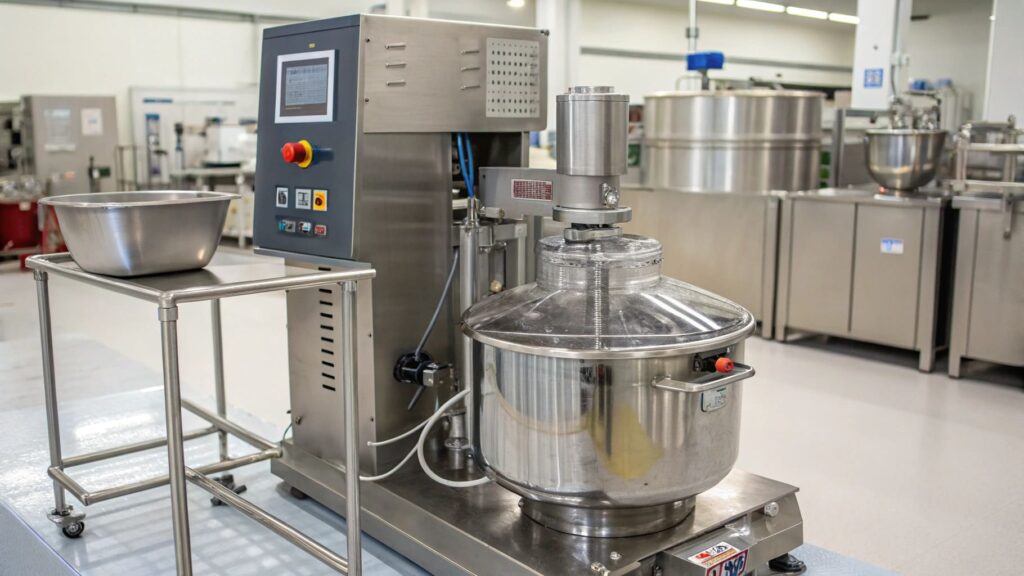
For large-scale semi-solid applications, the go-to solution is the planetary vacuum mixer. These powerful machines use a dual-action mixing pattern under vacuum, ensuring every particle is blended perfectly, which is essential for uniform, high-quality end products in demanding industries.

You know what equipment is used, but it’s the why and how that truly make a difference in production. Let’s explore the mechanics that make these mixers the industry standard and how they can solve some of your biggest manufacturing challenges.
How Do Planetary Mixers Handle High-Viscosity Materials?
Are you finding that thick, stubborn materials just won’t mix properly? This can lead to clumping and inconsistent batches, a real headache for any production manager.
Planetary mixers conquer high-viscosity materials through a unique dual-rotation system. High-speed dispersers apply intense shear to break down clumps, while slower planetary blades sweep the entire vessel, ensuring no material is left untouched and eliminating those frustrating "dead spots."
The Science of Powerful Mixing
The magic of a planetary mixer lies in its coordinated motion. Think of it like planets orbiting the sun while also spinning on their own axis. One or two mixing blades rotate on their own axes while simultaneously revolving around a central point in the mix tank. This ensures they pass through every point of the vessel. We design these systems to create a combination of shear and laminar flow, which is crucial for homogenizing semi-solids.
I remember talking with an R&D director at a battery company, a brilliant guy much like Dr. Michael Chen, who was struggling with lithium-ion battery slurries. The high viscosity was creating uneven particle distribution with his old equipment. When we showed him how our planetary system works, especially the way our custom-designed blades could handle his specific material, it was a breakthrough moment for his process. This is where our experience in creating custom mixing solutions really shines.
Different materials may require different blade designs, which is a key part of the customization process.
| Blade Type | Best For | Mixing Action |
|---|---|---|
| Butterfly | Very high viscosity (e.g., sealants, doughs) | Kneading and folding |
| Frame | Medium to high viscosity with scrapers | Sweeping and blending |
| Twisted | Dispersing and homogenizing | High shear and vertical flow |
This design doesn’t just mix; it ensures nothing sticks. The blades often have scrapers that constantly clean the vessel walls, folding that material back into the mix. This is especially important in large industrial mixers where even a small amount of unmixed material can compromise a huge batch.
Why Is A Vacuum Feature Crucial For Semi-Solid Mixing?
You’ve finally achieved a perfect blend, but it’s riddled with tiny air bubbles. These invisible culprits can degrade your product’s quality and performance over time.
A vacuum environment removes air bubbles and other gases from the material as it mixes. This deaeration process is critical. It prevents voids, improves product density and stability, and can significantly extend the shelf life and performance of the final product.

The Impact of Air-Free Mixing
Entrapped air isn’t just a cosmetic issue; it can be a critical failure point. In battery slurries1, air bubbles create voids on the anode or cathode coating, leading to reduced battery capacity and lifespan. In pharmaceutical ointments or cosmetic creams, they can alter the dosage, texture, and stability. For industrial sealants, they become weak points where leaks can begin.
I was once called to a client’s facility in the cosmetics industry. They were making a luxurious, high-end face cream, but customer feedback mentioned an inconsistent texture. When we examined their process, we found microscopic air bubbles were the cause. Their existing mixer couldn’t remove them. By introducing one of our planetary vacuum mixers2, the mixing action spread the cream into thin layers, while the vacuum efficiently pulled out the air. The result was a silky-smooth, stable product that transformed their customer satisfaction. As the CTO of MIXERSTAR, stories like this are what drives our commitment to engineering excellence.
The key is maintaining absolute vacuum integrity throughout the cycle. A robust sealing system is non-negotiable. It ensures that once the air is out, it stays out. This process enhances the material’s final properties, creating a more dense, reliable, and professional-grade product. You can read more about our technical approach on our blog.
How Can You Scale Mixing From Lab To Production?
Your formula is a success in the lab’s one-liter beaker. But when you move to a 200-liter production vessel, the results are suddenly inconsistent and unpredictable.
Successful scaling requires geometric and dynamic similarity across your equipment. This means using mixers that are essentially scaled-down or scaled-up versions of each other, ensuring that key mixing parameters like tip speed and shear forces remain consistent, regardless of batch size.

A Smooth Path from R&D to Full Scale
One of the biggest pain points I hear from R&D Directors is the "valley of death3" between a successful lab-scale formula and full-scale production. The physics of mixing changes with volume, and if your equipment isn’t designed for scalability, you’re forced to re-engineer your entire process, which costs time and money.
The secret is ensuring your equipment provider offers a full range of sizes built on the same design principles. At MIXERSTAR, this is fundamental to our philosophy. We provide a clear pathway for our clients. A process developed on one of our small-scale planetary mixers (like a 1L or 5L model) in the lab can be confidently moved to a medium-scale mixer (15L or 30L) for pilot batches, and then to our large industrial mixers (from 60L up to 300L) for mass production.
We ensure that the bowl geometry, the ratio of the blade diameter to the tank diameter, and the power input per unit volume can be correlated across the sizes. This means less reformulation and a much faster time-to-market. If you have questions about scaling your specific process, feel free to reach out and contact us. It’s a journey we’ve helped countless clients navigate successfully.
Conclusion
In summary, choosing dual planetary vacuum mixers is the answer for large-scale semi-solid mixing. They provide the control, power, and scalability necessary for modern industrial production.
External Links
-
Understanding battery slurries is crucial for improving battery performance and longevity, making this resource invaluable. ↩
-
Exploring the benefits of planetary vacuum mixers can enhance your production quality and efficiency in various industries. ↩
-
Understanding the ‘valley of death’ can help you navigate the challenges in R&D and improve your product development process. ↩